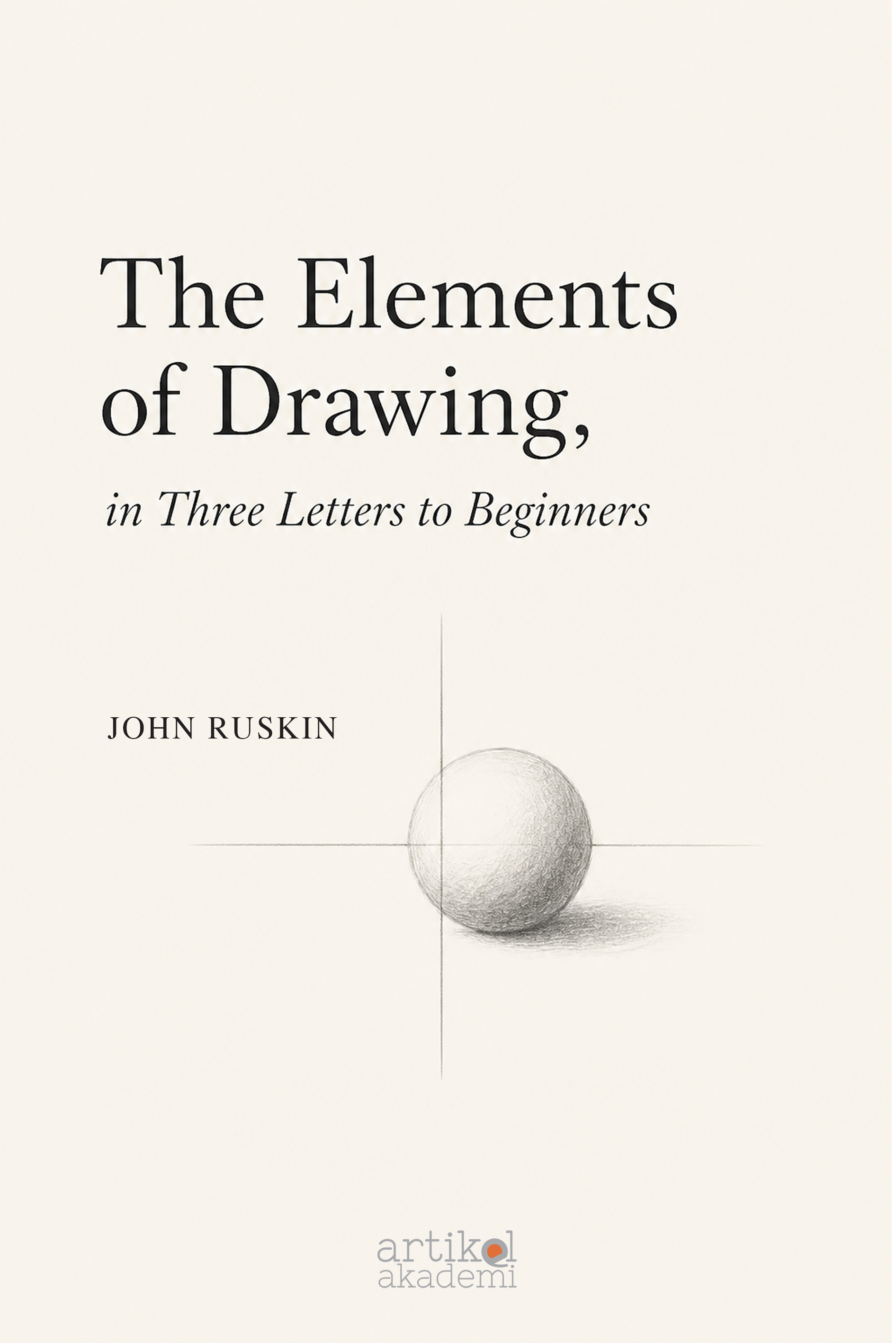
The Discipline of Sight: Re-evaluating John Ruskin’s The Elements of Drawing
First published in 1857, John Ruskin’s The Elements of Drawing; in Three Letters to Beginners remains one of the most influential treatises on art education and visual perception in the history of Western aesthetics. While often categorized as a practical manual, this work transcends the boundaries of technical instruction, offering a profound philosophical inquiry into the act of seeing and the ethical responsibility of the artist toward the natural world.
Writing at the height of the Victorian era, Ruskin sought to dismantle the rigid, formulaic methods of the contemporary art academies. His pedagogical approach, presented through three intimate yet rigorous "letters," advocates for a return to nature—not as a subject to be mastered, but as a teacher to be observed with humility and precision.
This new edition reintroduces several core Ruskinian concepts that continue to resonate within contemporary visual arts and design theory:
The Innocence of the Eye: Perhaps Ruskin’s most radical contribution, this concept urges the artist to strip away conceptual labels and preconceived notions. To see with "innocence" is to perceive the world as a vibrant arrangement of light, shadow, and color before the intellect intervenes—a theory that prefigured the Impressionist movement and modern perceptual psychology.
The Ethical Gaze: For Ruskin, drawing was a form of moral engagement. He believed that the disciplined study of a leaf, a stone, or a cloud was an act of reverence for the intricacies of creation. In an age of rapid industrialization, his work served as a reminder of the vital connection between human creativity and the organic environment.
Methodological Sincerity: Through his detailed guidance on line, composition, and color, Ruskin promotes a "sincerity" of execution. He rejects superficial brilliance in favor of a patient, iterative process that refines both the hand of the artist and the character of the observer.
In our current era, dominated by rapid digital consumption and synthetically generated imagery, Ruskin’s insistence on the "slow art" of observation is more relevant than ever. This book is an essential resource not only for practitioners of fine arts and architecture but for anyone seeking to cultivate a deeper, more intentional relationship with the visual world.
We are honored to present this classic text in its original brilliance, inviting a new generation of scholars, students, and enthusiasts to rediscover the transformative power of the Ruskinian gaze. As Ruskin famously asserted, “To see clearly is poetry, prophecy, and religion, all in one.”